
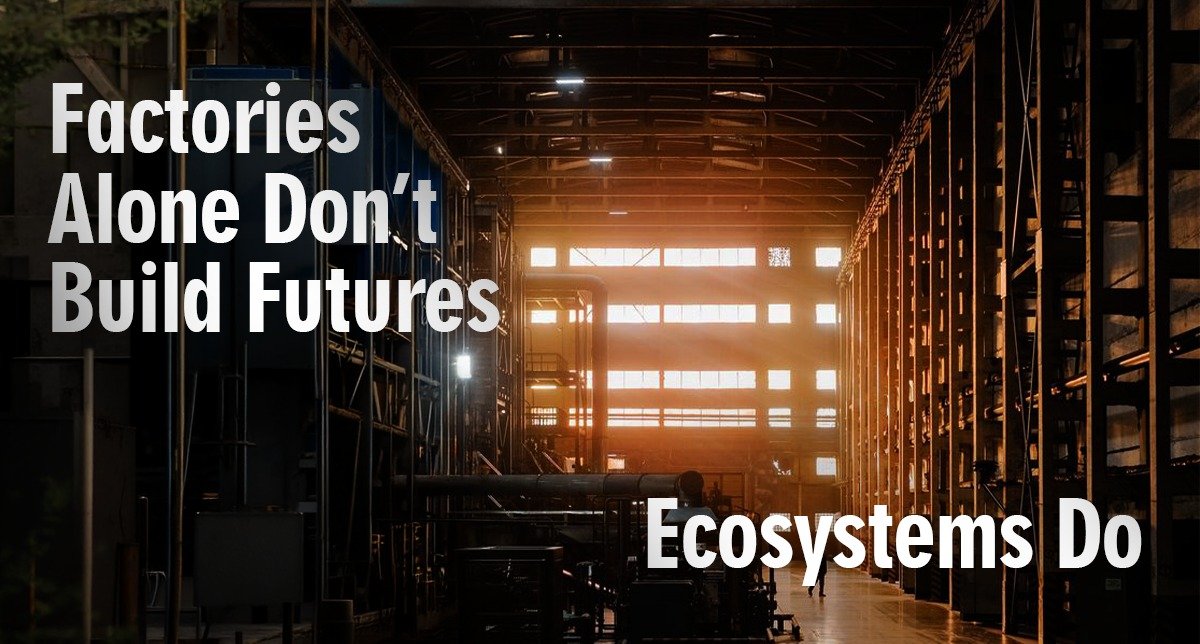
There was a time when the idea of development was simple.
It sounded logical, mechanical. Input capital, output prosperity. For decades, this industrial formula shaped how governments, planners, and investors imagined progress.
But the world changed.
And somewhere along the way, we realised something uncomfortable, which is that factories can generate output, but they don’t automatically generate futures.
A future is a living thing. It is supposed to be messy, interconnected, and deeply human. It needs more than production lines and warehouses. It needs networks, it needs culture, and most importantly, it needs infrastructure. As a bonus what it also needs is talent, quality of life, and opportunity loops. In short, it needs an ecosystem.
You can build ten factories in a district and still fail to create a thriving region. But build one strong ecosystem, and industries will come on their own. That’s the shift.
And honestly, we’re seeing it play out right now across multiple growth corridors in India.
Take the Tricity region for instance, Chandigarh, Mohali, and Panchkula. On paper, it was never just about factories. It was about planned living, education hubs, healthcare access, green layouts, and a balanced urban rhythm. Over time, industries, IT parks, startups, and service sectors followed naturally. They did not emerge artificially. They emerged because the ecosystem made it viable.
That distinction matters more than we admit.
Because factories alone can create employment, yes. But ecosystems create retention.
And retention is the real economic multiplier.
A worker who earns in a factory but has to migrate for better schools, hospitals, or lifestyle eventually leaves. A professional who cannot find cultural spaces, mobility infrastructure, or social networks will not stay long-term. The result? Regions become transactional instead of transformational.
This is why many industrial clusters globally stagnate after an initial boom. They scale production, but not people’s lives.
Meanwhile, ecosystem-driven regions compound growth in layers.
First comes infrastructure. Then education. Then residential demand. Then retail. Then innovation. Then capital. Then culture. Then identity.
And suddenly, you’re not looking at an industrial zone anymore. You’re looking at a self-sustaining economic organism.
It breathes. It adapts. It evolves.
Interestingly, policymakers are slowly acknowledging this shift. Earlier, incentives were mostly land + tax + factory permits. Now the conversation includes mobility corridors, green planning, social infrastructure, and integrated townships. Not because it sounds good in brochures. But because data shows that productivity and investment longevity are directly linked to liveability.
There’s also a psychological layer here that rarely gets discussed.
Factories create jobs. Ecosystems create belonging.
And belonging is underrated as an economic force.
economic leakage reduces dramatically. Spending stays local. Entrepreneurship rises organically. Services diversify. A micro-economy forms within the macro-economy.
That’s when true regional wealth begins to circulate instead of just passing through.
Look at how modern growth hubs are evolving now. They are no longer pitching “industrial plots” in isolation. They’re presenting mixed-use ecosystems: workspaces, wellness spaces, residential zones, connectivity networks, and environmental planning stitched together. Because investors today don’t just ask, “Where will the factory be?” They ask, “Where will the people live? Commute? Grow?”
It sounds obvious, but for decades, it wasn’t the core strategy.
Another overlooked reality- automation.
As factories become more automated, they employ fewer people per unit of output. Which means the old model of mass industrial employment is shrinking. If a region relies solely on factories for growth, it risks economic fragility in the long run. One technological shift, and employment density drops.
But ecosystems are more resilient.
They diversify economic engines so manufacturing, services, innovation, logistics, education, healthcare, and lifestyle sectors co-exist. If one sector slows, others absorb the shock. That kind of layered resilience is what defines future-ready regions.
Even investor psychology has evolved. Earlier, capital chased production capacity. Now it chases long-term viability. And viability is deeply tied to ecosystem maturity.
It’s why airport corridors, expressway-linked regions, and integrated townships are seeing disproportionate attention. This isn’t because factories suddenly became irrelevant. But because connectivity + liveability + accessibility together create exponential value.
Factories plug into ecosystems. Not the other way around.
There’s also a softer, almost philosophical angle to this conversation. Development used to be measured in GDP, output, and industrial density. Now there is a growing emphasis on wellbeing metrics, environmental balance, and quality of life indicators.
A place that produces wealth but erodes health, environment, and social cohesion eventually faces invisible costs.
Healthcare burdens.
Migration churn.
Urban stress.
Infrastructure strain.
Ecosystems, when designed consciously, attempt to reduce these hidden costs.
And that’s where the Tricity model becomes instructive again. It didn’t explode overnight like a typical industrial boomtown. Its growth was gradual, layered, and somewhat balanced. Education institutions fed skilled talent. Urban planning supported liveability. Healthcare infrastructure attracted families. Businesses found stability in that equilibrium.
This isn’t about perfection, this is about sustainability.
Compare that with purely industrial belts that struggle with pollution, workforce churn, and uneven urban planning. The difference is structural.
Another thing worth saying, ecosystems attract innovation far better than isolated industrial zones. Startups, research centres, and knowledge economies thrive where talent wants to live, not just work. Cafes, co-working spaces, universities, and social hubs indirectly influence economic dynamism more than we acknowledge in policy reports.
You cannot manufacture innovation on an assembly line. You cultivate it in an ecosystem.
And maybe that is the core thesis of the future economy.
Factories will always matter. Manufacturing is foundational. Supply chains are critical. Industrial output drives national growth. But the belief that factories alone can shape a region’s destiny feels increasingly outdated.
They are necessary, not sufficient.
Because at the end of the day, economies are not run by machines.
They are run by people who decide where to live, where to work, where to raise families, and where to invest their time and energy.
And people don’t choose factories.
They choose ecosystems.
Maybe that’s the shift happening across emerging growth regions today. A move from isolated industrial thinking to integrated developmental thinking.
From output-centric planning to life-centric planning.
From factories as endpoints to ecosystems as foundations.
And once you see that shift clearly, it becomes difficult to unsee.
Factories can spark growth.
But ecosystems sustain it.
Factories can create activity.
But ecosystems create futures.
And the regions that understand this distinction early won’t just grow faster. They’ll grow wiser.

A PLPB initiative driving industrial growth in India.
Copyright © 2026 IndusPark